
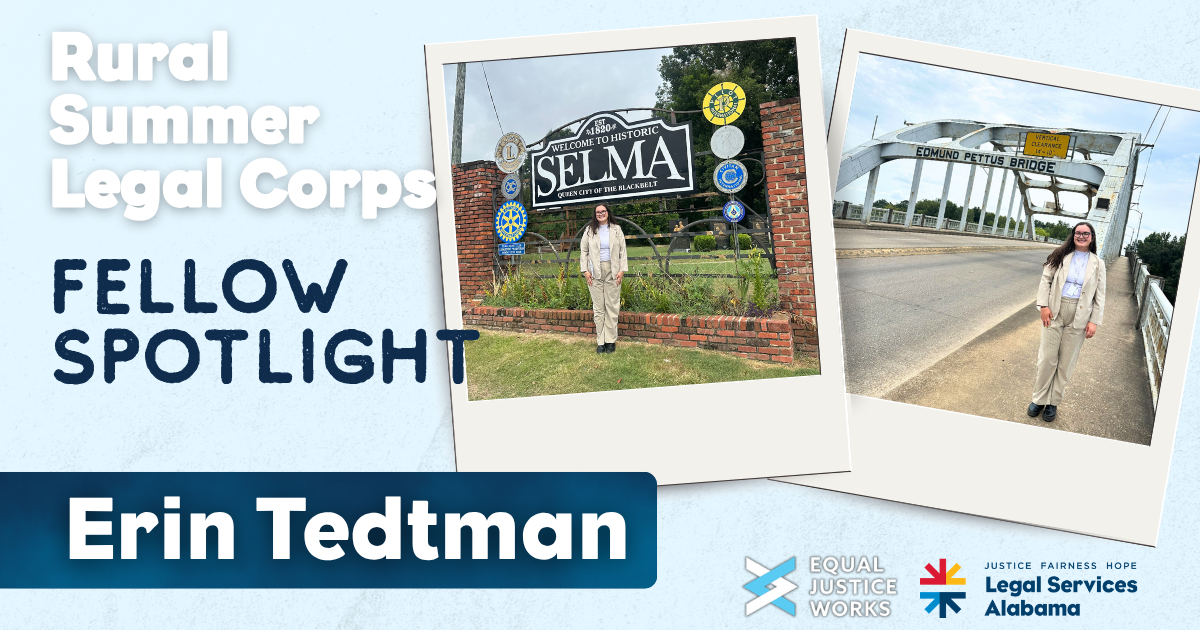
by: J. Jackson, Communications Manager

As a Cincinnati native Erin Tedtman grew up in an urban setting. Similarly insular to other major cities, the two worlds of “urban” and “rural” rarely meet. Ready access to things like business districts and public transport add to the allure of inner-city living over the suburbs. But surrounding the city, surrounding the suburbs, is the rural expanse small towns call home.
Mysterious to some, romanticized by others, rural living is widely misunderstood.
Unfamiliar with these cultural intricacies, Erin embarked on a journey to deepen her commitment to access to justice by deepening her relationship with the spaces that felt most foreign. Disenchanted by her fellow law students’ desire to immediately plant roots in major metropolises upon graduation, Erin decided on a path of discovery.
“When I learned about the Rural Summer Corps Fellowship I thought it was an interesting space for me. I would learn about another place—a place I probably wouldn’t have ended up otherwise. I applied for a position in the South because it is a place that is often overlooked,” she said.
“I had time to explore and felt I should take advantage of it.”
Through the Equal Justice Works Rural Summer Legal Corps (RSLC), Erin found her route to exploration, and it led to Alabama.
Equal Justice Works partners with Legal Services Corporation (LSC) to “support dedicated law students who want to serve rural communities” through the RSLC program.
Aware of the deep-rooted historical legacy associated with Selma, Erin was drawn to the Black Belt region.
“The root of LSA’s mission, I think, is seen in Selma. This is where we need to be if we really want to fill the justice gap,” she said.
She began to understand lawyering in rural areas as a microcosm of the urban-centered priorities shared by her law school classmates.
“They all want to move to the coasts. If they wanted to go to Alabama I’m sure they would pick a place like Birmingham. They don’t want to go to more rural areas.”
Erin’s challenge to herself turned to facing the legal challenges of working in a law office in a town like Selma. Quickly, she began to meet with the clients where she was able to build a first-person relationship with both residents and the long-term effects of systemic poverty.
“I met 80-year-olds coming in to file bankruptcy. It’s like it just never ends. Truly $200 can change the trajectory of what happens next in their lives,” Erin recounted.
While the vast majority of LSA clients make too little to even qualify for a wage garnishment, consumer issues make up around 15% of LSA’s annual case load. In 2025, over 85% of LSA consumer cases involved bankruptcy or garnishments.
These dire disparities pushed Erin to fully immerse herself in the world of rural legal aid where she began developing courtroom skills while shadowing LSA attorneys.
Surprised by the lackadaisical attitude of debt collection agencies, Erin found that predatory lenders rely on scared and confused clients to pay rather than seek legal counsel. She discovered that frequently the agency wouldn’t even send their own attorney, but rather 3rd party representation would arrive in court. Unfamiliar with the details of the cases, these lawyers were ill-prepared as legal representatives.
What struck Erin most were the lengths to which a company, like a debt collection agency, would go to extract $200 from a person living with so little.

Selma is housed in a region known as the Black Belt. Named for its rich soil deposits, it is one of the most impoverished areas of the state. It isn’t uncommon for clients to present with debt, with benefits issues, or with a housing crisis.
Homelessness prevention and criminal record expungements were other core service areas that inspired Erin. Knowing that organizations like LSA cannot eradicate the myriad issues that contribute to poverty, Erin was thankful to be part of the fight to close the access to justice gap.
“Just having a brick-and-mortar spot for people to go—I think it is really important. And at least they have the chance to feel heard in this one moment with you. They may not feel that way in any other circumstance, but we can hopefully make them feel supported,” she said.
“It’s a collaborative experience working with clients in any issue area. I didn’t do it on my own—we did it together. It’s our success, not just mine.”
Erin’s time with LSA taught her far more than the ins and outs of civil procedure.
“The first year of law school is famously the worst because it’s all doctrinal and it’s just not fun. And so, coming here, I felt, ‘Okay, this is why I’m in law school,’” she said.
“It’s not because I want to go sit in a classroom for five hours and talk about the law. But to work with people and to see how I can use it to help someone. I think that was very energizing for me.”
Erin’s time with LSA is not the end of her public service training. Her goal now is to maintain similar training opportunities for her remaining semesters of law school. She encourages others to follow her lead.
“These practical experiences, I think that is where you learn the most. It’s the most valuable training. And doing this kind of boots-on-the-groundwork should ground you in the role of a lawyer,” she said.
“Direct client services and public interest work are foundational.”